Sometimes things happen for a reason. Sometimes an accident can be fortuitous. Sometimes the universe aligns in funny ways…
Like when your son smashes a pasta bowl from your favourite set. And that makes you sad… And then you see an advert for a Kintsugi workshop. And ‘try a new craft’ is also on your list of things you want to try in 2025…
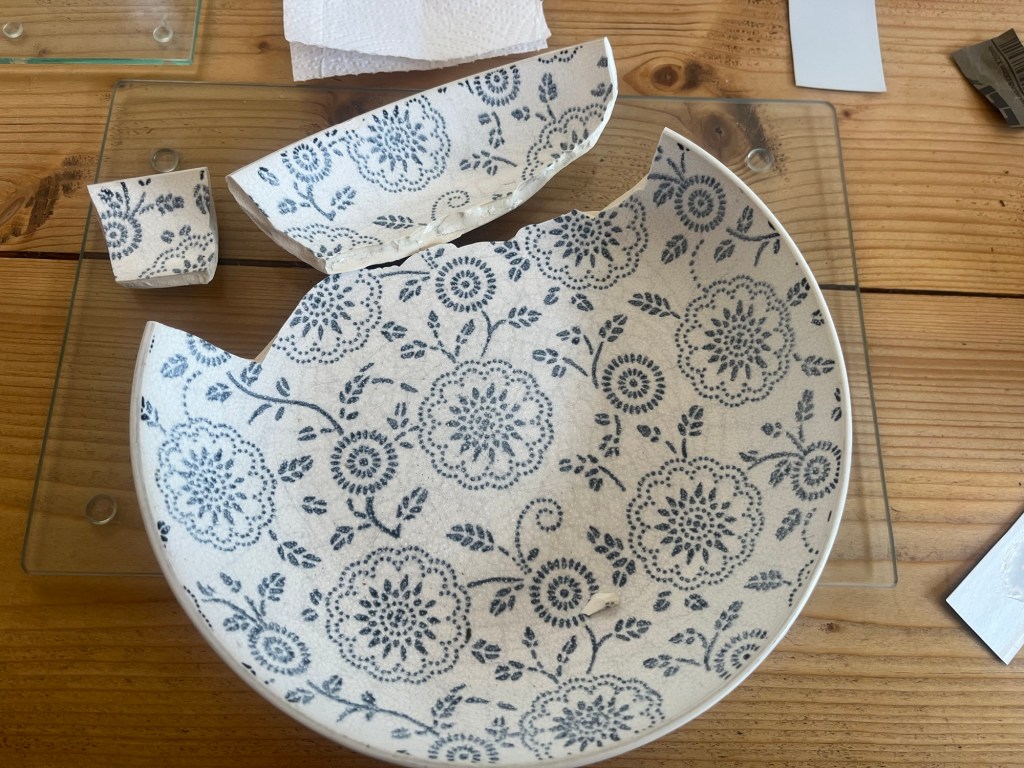
And so it was that bright and early on the morning of 8th May I hit the road headed for Stroud, where the lovely Clara Bethell-Smith was running a Kintsugi workshop. (I saw her workshops advertised on a visit to Westonbirt Arboretum, but that venue books up very quickly!). We were based in the Cacao House, a lovely little independent chocolate shop and cafe tucked away in the town centre. There were six of us in the class, all with broken pots, plates, bowls and even a hand-built pottery horse with a broken leg, ready to be given a new lease of life.
Kintsugi is the Japanese art of repairing broken pottery by visibly mending the breaks using urishi lacquer, sometimes dusted with a gold finish. It literally translates as ‘golden joinery’, and as a philosophy it treats breakage and repair as part of the history of an object, rather than something to disguise. There is something quite appealing about embracing the flawed and imperfect, and of accepting that even objects change during their lifetime and this does not mean they become useless. Actually, I quite like that as a philosophy for me, not just for my pasta bowl 🤣
The repair process was one with several stages. I decided I would need an initial cup of cacao as fortification. (It was delicious!) Firstly, we had to prepare the surfaces that were to be repaired by lightly sanding. Then the application of an epoxy glue and the important step of fitting the broken pieces together as well as possible, holding them in place until the glue had set enough to keep them there. Patiently waiting until the glue was no longer tacky, we then had to scrape away any excess with a craft knife.
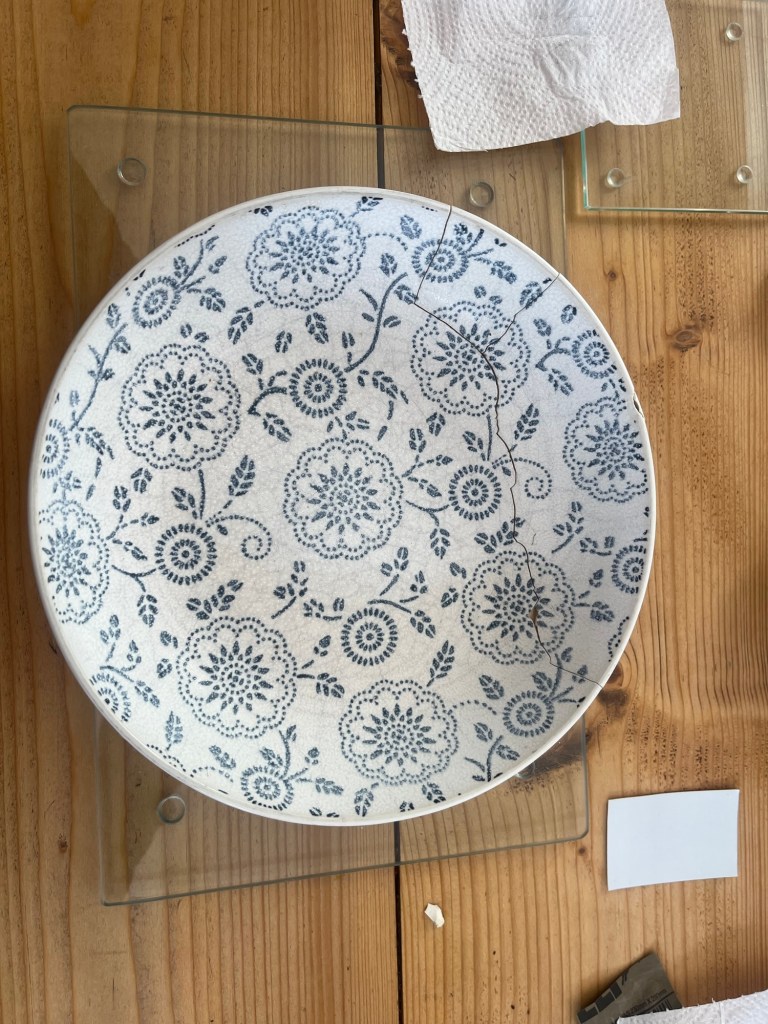
The next stage was to fill the cracks with the craft equivalent of polyfilla! The cracks in my bowl were quite deep and quite long, so this part of the process took me a while. Smoothing the filler into the cracks with my fingers, and importantly taking off any excess (with a tiny scraper) in readiness for the application of the urishi. Had time been no object, spending more time on this step would definitely have been beneficial.
Urishi is a tree- derived red lacquer, highly characteristic of Japanese decorative pieces throughout the ages. It can cause skin reactions, so we had all been advised to wear long sleeves and were provided with plastic gloves to wear as we worked with the urishi. We used very thin brushes to apply it in a line along the joins we had prepared. Our tutor showed us an urishi-application brush she had had sent from Japan, which was made from mouse hair – which gives you an idea of how delicate this part of the operation was! Once we had painted, our pieces of pottery had to sit in a warm, damp box for at least 10 minutes for the urishi to set/cure. (Just enough time for more cacao…)
The next stage was the application of brass powder, to get the golden finish to the repair. Whilst urishi is food-safe, brass powder is not, so since I am hoping my pasta bowl will become useable again I applied the brass powder only to the outside of the bowl, leaving the inside in the urishi-red. We used a soft-bristled brush with the powder, tapping it onto the almost-set urishi and sweeping the excess into the ‘cracks’. This again had to rest in the box for 15-20 minutes to begin setting.
That was the final step of the workshop, but the final step for us was to transport the piece home, leave it overnight and then wash off any excess brass powder that had not set into the urishi. Which I have dutifully done.
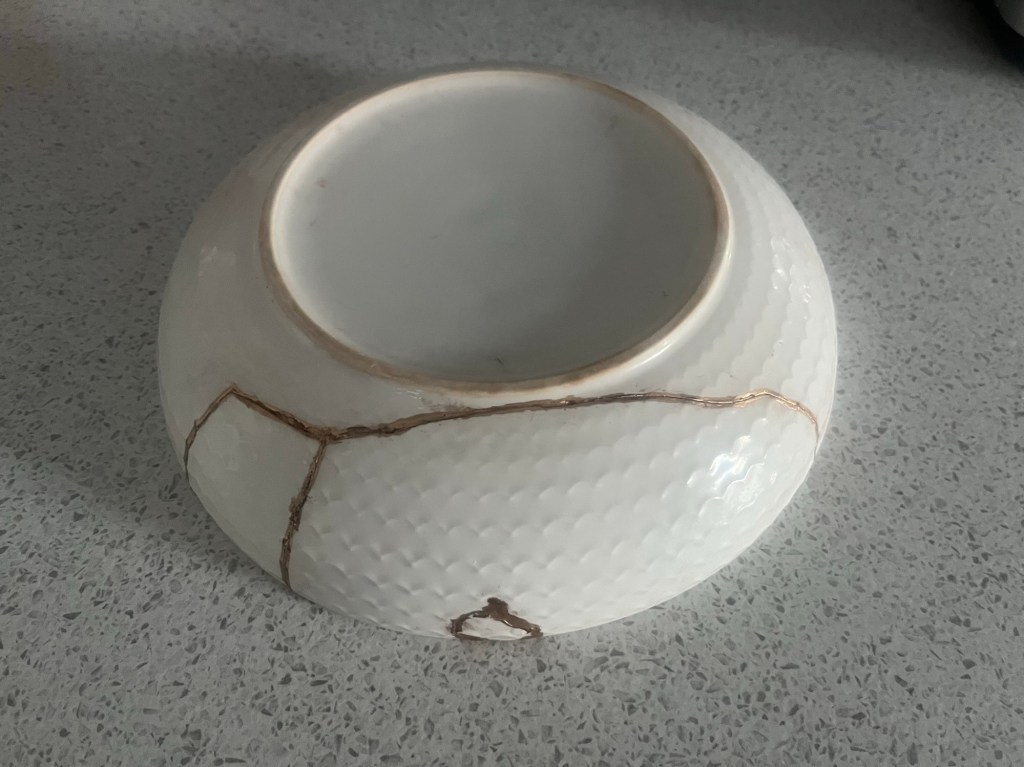
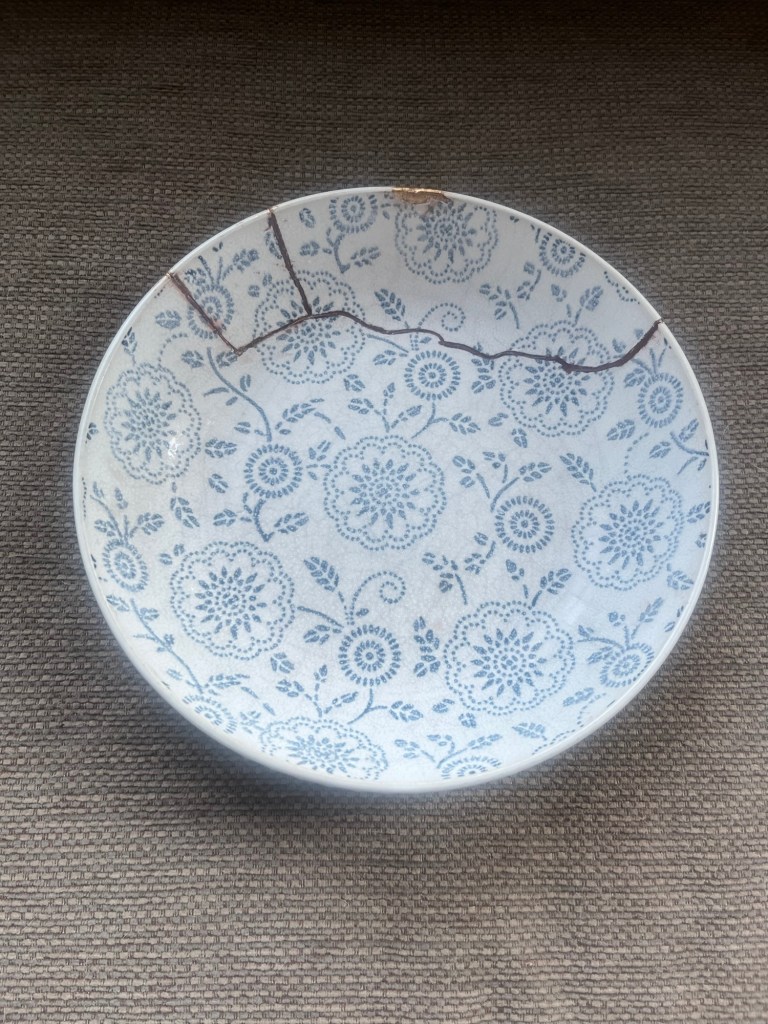
I’m really pleased with the outcome. The perfectionist in me knows that the pieces could be better aligned, the cracks could be better filled, the urishi could be more accurately painted… etc etc… But isn’t the whole point of this craft to embrace imperfection? I love that my bowl is whole again, and feel very proud of my first Kintsugi efforts.
If you fancy trying it I would thoroughly recommend Clara’s workshops. She also will restore pieces for you if you’re looking for a professional repair. You can find her on Instagram at @clarakintsugi or via her website https://www.clarakintsugi.com
 50shadesofbrave